
 When a medical device is thought to have contributed to the death or serious injury of a patient, the manufacturer of that device is required by federal law to report that event to government regulators. Now, there is strong evidence to suggest that the FBI is investigating the possibility of criminal wrongdoing by Johnson & Johnson, as well as other manufacturers of power morcellators, for their failure to do just that.
Power morcellators are devices intended for use in laparoscopic surgery procedures. Rather than fully opening the surgical site, a series of tiny incisions are made in the patient and the morcellator is inserted into the area requiring surgery. An electrically operated blade then cuts the targeted tissue free and then slices it into pieces small enough to be removed through the initial holes.
When used during gynecological procedures such as hysterectomies and myomectomies to treat uterine fibroids, the device can spread as-yet-undiagnosed uterine cancer throughout the patient’s abdomen.
Drs. Amy Reed and Hooman Noorchashm have rocketed to the forefront of the anti-morcellator movement for their relentless efforts to get this danger acknowledged at the federal level. Among other goals, they are pushing for legislation of power morcellators that will help prevent women from unknowingly and severely affecting their prognosis for a cancer that they may not even know that they have.
Their struggle began in 2013 when Dr. Reed underwent a hysterectomy via morcellator which spread uterine cancer throughout her abdomen. Since then, she has undergone chemotherapy, massive surgeries, and the removal of part of her spinal column as she fights leiomyosarcoma. She is 42 and a mother of six.
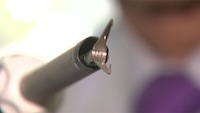 Reed’s husband, Dr. Noorchashm, has been a vocal critic of morcellator manufacturers and reports that he, his wife, members of his professional circle in the medical community, and other victims of cancer spread by power morcellators have been contacted by the Federal Bureau of Investigation. Agents appear to be exploring whether morcellator manufacturers failed to report the deaths and other injuries caused by their devices.
Dr. Noorchashm says that he has been trying to get the FBI on the case for a very long time. His efforts finally appear to be working. “The FBI’s questions surrounded how much the company knew and, despite knowing, how it continued marketing” its device, says Noorchashm in a May 28th story on Philly.com.
While the FBI refuses to comment on on-going investigations until formal charges are filed, the sheer number of contacts being made by FBI agents with doctors and morcellator patients shows that something has stirred the government to action. Pathologists, doctors, physician assistants, and patients are being interviewed and sharing the results of their research into the issue with federal agents, including a list of 400 women who underwent morcellation and then suffered from aggressive uterine cancer.
Whether the FBI will press formal charges against Johnson & Johnson and other morcellator manufacturers remains to be seen. They certainly appear, however, to be laying the groundwork for some sort of action.


